








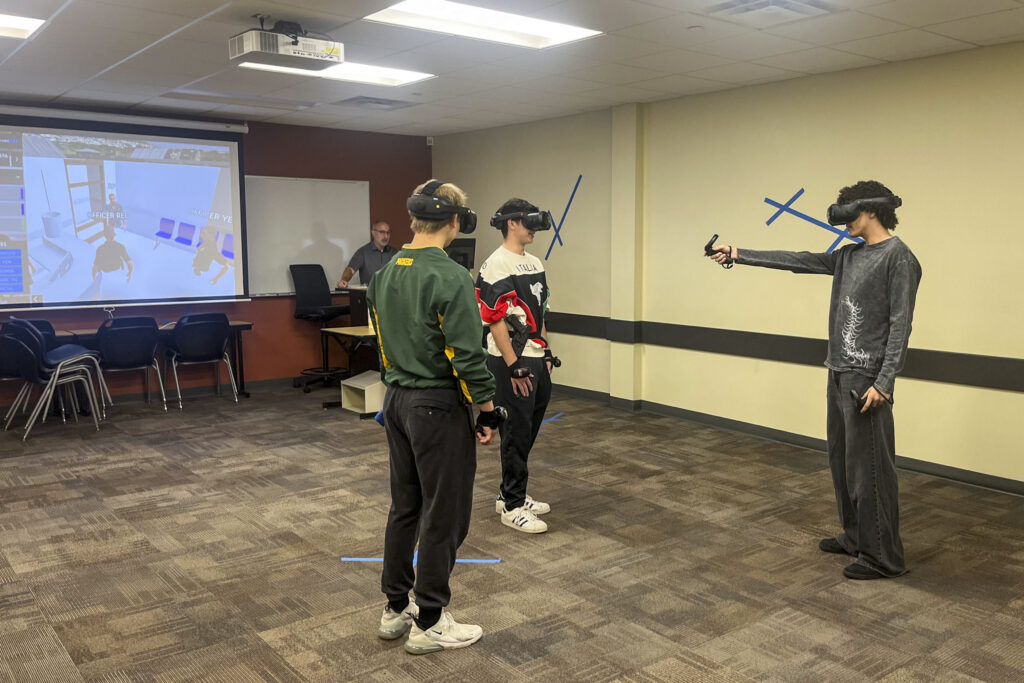
Kirkwood Community College’s criminal justice program has introduced virtual reality to give students hands-on experience with situations they may encounter in law enforcement.
The system they are using is called Operator XR, a 3D virtual reality training simulator designed for police, military and other public safety and security agencies.
Jeff Hembera, assistant professor of criminal justice, has experience with law enforcement. After graduating from Kirkwood, Hembera worked at the Anamosa State Penitentiary for three years before joining the Cedar Rapids Police Department in 1992. During his 31-year career, he served as a patrol officer, sergeant, lieutenant and captain before finishing in administrative operations.
Hembera had prior experience with VR while in the CRPD. He used a system called VirTra, which inspired him to start virtual reality at Kirkwood.
“That’s what kind of got me into the idea of looking at these training systems and how we could incorporate that into our classes,” he said.
Hembera said its not being forced to use Operator XR but are using it to allow students to experience constitutional issues. The issues students were able to experience were stop-and-frisk, first amendment auditors and many others.
In these situations, there are usually two people acting as police officers, and either a student or professor acting as a role-player. The officers try to handle the situation, and the role-player tries to act out prompts they are given.
“All of a sudden, you’re putting that person and immersing them in an actual situation,” said Hembera. “The feedback we’ve gotten has been really fascinating because they’re saying, ‘Oh, this is totally different.’”
For Ryder Banks, criminal justice, the simulations gave him opportunities to learn from mistakes before encountering situations in the field.
During a stop-and-frisk scenario, Banks served as an officer and was called to a scene where a suspect had a knife. The suspect then threw the knife, and Banks focused on the fact that the knife was thrown instead of considering the possibility they may have another weapon.
“When he threw the knife my first thought wasn’t ‘OK, I need to keep myself safe.’ It was ‘I got this dude throwing a knife; now I have evidence on him,’” Banks said.
He reviewed the scenario with Hembera, and Banks realized he needed to consider his safety and the possibility that the suspect could still be armed.
“That’s not even something I thought of,” Banks said.
The VR training began in October, so it is still a learning experience.
“The whole idea of training is to put people in situations where they can have a little bit of freedom to try different things, and when it doesn’t work, it’s OK because you’re in a safe environment and nobody is hurt,” Hembera said. “This is the time to find out what works and what doesn’t work.”
For Hembera, the goal of using VR is to help ensure that students are ready for their future careers in law enforcement.
“It’s all about preparation. It’s making sure that they are prepared to go out and do the job,” he said.
Categories: News