







“1. Sit down. 2. Shut up. 3. Disturb no one. 4. Be invisible.”
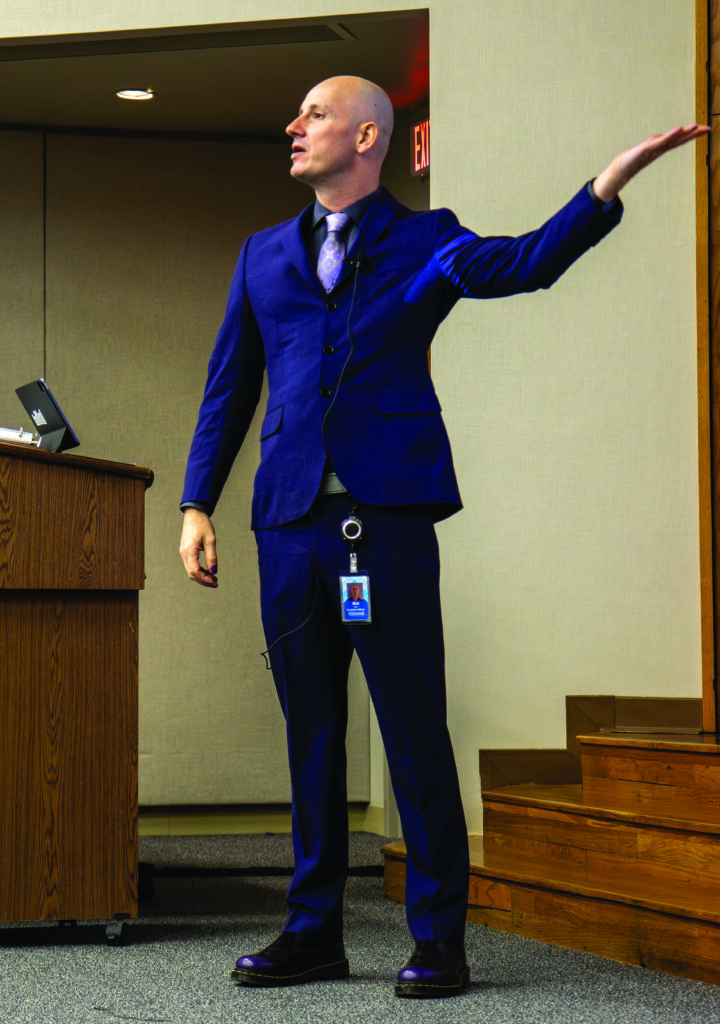
These are the unspoken rules most people follow when they go to a movie theater. The expectation of staying silent feels natural, but where did it originate? Matt Foy, instructor of speech communication at Kirkwood Community College, explored this question on Nov. 6, during a faculty lecture in Cedar Hall.
Foy said he began studying the subject in 2010 as a graduate student, when he wrote a paper on why people talk during movies. Since then, has continued to research the history and cultural implications of purposeful movie talking.
To understand today’s etiquette, Foy said it’s essential to look back to a time when audiences behaved very differently. Hundreds of years ago, attending a performance was anything but a silent experience. Shows attracted lively, vocal crowds, including groundlings and the peanut gallery, typically poorer audience members who stood in front of the stage. These spectators freely expressed their emotions, often shouting at performers, cracking jokes or tossing peanuts, which were the popular snack in the cheap seats. Noise was not simply tolerated; it was part of the entertainment.
This tradition persisted until filmmaker Alfred Hitchcock shifted expectations. When “Psycho” was released in 1960, Hitchcock insisted that theaters prohibit late entry. The change elevated the importance of punctuality and silence.
As Foy noted, “We’ve definitely entered the age in which sitting down and shutting up is the law and the word.”
Foy dedicated the second part of his lecture to “Mystery Science Theater 3000,” a cult classic television show that openly challenges expectations about audience behavior.
The series features a human host and his robot sidekicks watching bad movies and firing off rapid jokes throughout, sometimes 500 to 700 per episode.
Foy described this practice as “movie riffing, the art of audience members responding to a movie with conspicuously humorous, sarcastic, or critical commentary.”
In 2024, Foy and co-author Christopher J. Olson published “Mystery Science Theatre 3000: A Cultural History.” The book examines the show’s cultural influence, exploring how its humor, style and distribution model anticipated broader shifts in media production and criticism.
The show defied the norms of silent viewing, but Foy supports the practice. “The more you riff, the more you build up your vocabulary,” he said.
Riffing also encourages audiences to interact actively with movies rather than passively consume content.
He closed with a challenge to the audience. “Where did we get the idea that sitting down and shutting up is the only acceptable behavior, and who taught you what you have to say is less important than what somebody puts on a screen in front of you?”
Categories: News