








In a state where agriculture, transportation and heavy machinery power the economy, diesel technology remains a quiet but essential force.
At Kirkwood Community College, the Diesel Technologies program is training students not to farm the land but to keep the machines that work that land and much more running efficiently.
The program focuses primarily on diesel engines used in agricultural, truck and heavy equipment. According to program instructors, especially Lance Dvorak, while many students come from farming backgrounds, the training itself is strictly technical.
“It’s mainly diesel,” Dvorak explained. “We specialize in agricultural equipment and semi and heavy equipment. It’s a hands-on degree where students learn the basics of diesel technology and diagnostics.”
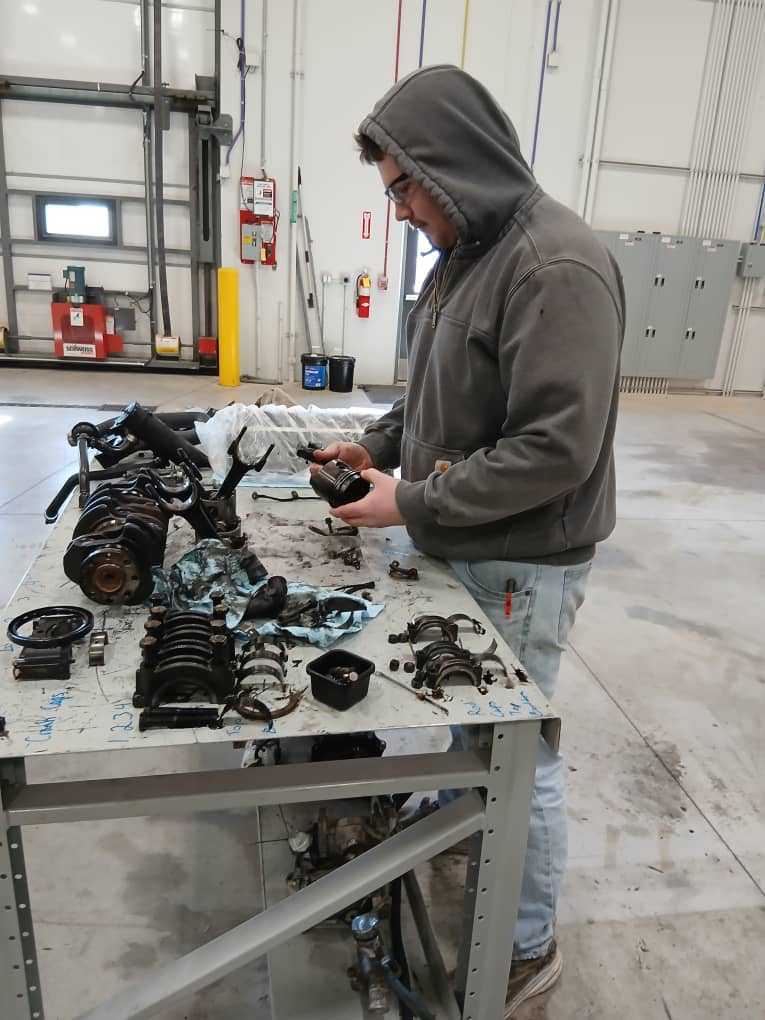
Students in the program work on tractors, trucks and other heavy machinery, learning how to diagnose problems, pull engines apart, repair and rebuild them.
The focus is on fixing machines, not operating them.
“We’re just fixing the machine,” Dvorak said. “We don’t do rural or crop work. That’s not our job. We focus on repair.”
While many students grew up around farms, the program attracts a diverse group from Cedar Rapids and surrounding areas. Some return to work on family farms, but many go on to jobs in independent shops, local companies or through internships that often lead to employment.
A key part of the program is its internship requirement. Students must complete 160 hours of industry experience, typically during the summer. Kirkwood supports this process by hosting career fairs and mock interviews to prepare students for the workforce.
“Industry people come in to do mock interviews,” Dvorak said. “We try to help students find a place to complete their internship requirement. It’s a big step toward employment.”
Enrollment in the program is competitive. Each year, Kirkwood accepts only 22 students into the truck and heavy equipment track and another 22 on the agricultural side.
Because of limited space and equipment, students who are not admitted often have to wait until the following year. Despite the limited capacity, interest in the program remains strong.
“We really haven’t worried much about getting our name out there,” Dvorak noted. “Enrollment has always been consistent.”
For students, the appeal is clear practical skills, hands on learning and direct pathways into stable careers.
Keegan Rushford, a student in the program, said his interest in mechanics began at a young age and grew through real world experience.
“I was interested in mechanics early on,” Rushford said. “I worked in a semi shop before coming to Kirkwood, and I enjoyed it. I knew this was what I wanted to do.”
Rushford added that the program has helped clarify his career goals. “Kirkwood has really set me up with the knowledge and experience I need,” he said. “I’d like to work in a shop after this—either a semi shop or a tractor shop. I’m still deciding, but I know I’m in the right field.”
As Iowa continues to rely on heavy equipment across agriculture, transportation and industry, programs like Kirkwood’s Diesel Technologies ensure that skilled technicians are ready to meet that demand.
While the work may be behind the scenes, its impact keeps entire systems moving.
Categories: Feature