








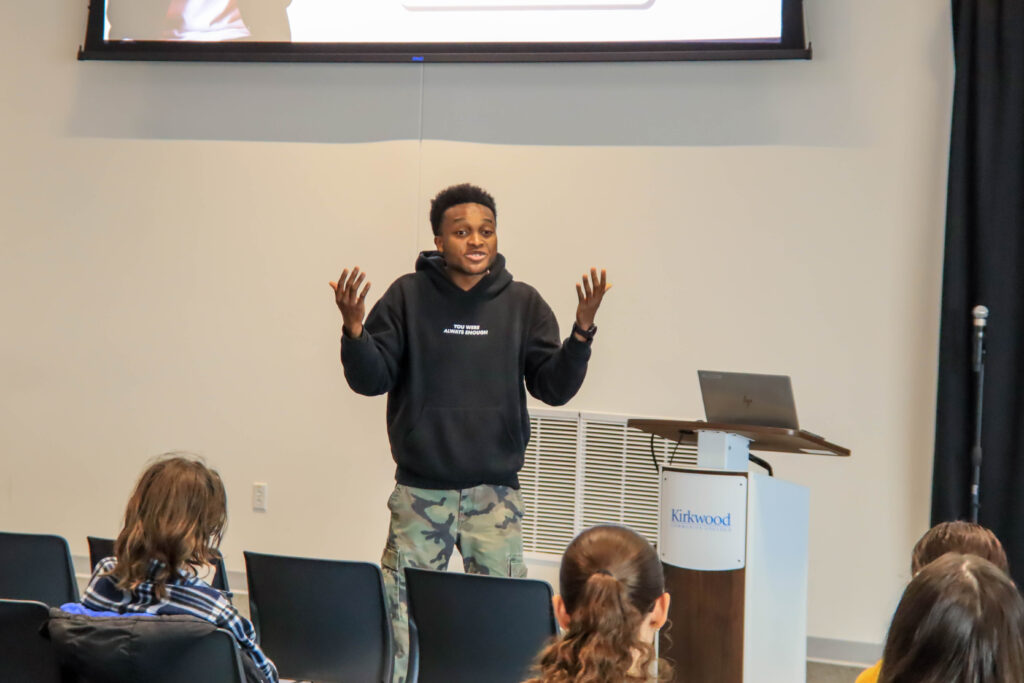
Kirkwood Community College students were scattered across Iowa Room A and B, posing in powerful stances like superheroes. In the next few minutes, a laugh attack spread across the floor.
On Feb. 17, Wes Woodson, mental health advocate and public speaker, appeared as part of the Eagle Leadership Series to teach students how to implement self-care practices into their daily lives.
He described what self-care actually looks like in a busy world and provided multiple ways to practice self-care, with live demonstrations during the event.
Some people think self-care is an instant fix, but while that may be true in the short term, Woodson compared self-care to a tool in your toolbox that is used daily to function rather than as a one-time, fix-all solution.
“It has to be a consistent practice, for them to show up as their best, it’s not like a one-and-done. It’s not something you can just do and feel better,” Woodson said.
Woodson said that when we try to change our state of mind, we typically choose one of two solutions, which he described as “numb” and “nurture.”
The “numb” approach is a distraction and a short-term solution to our situations. “Nurture,” on the flip side, is a supportive and sustainable change in our lives.
This was the part of the event where Woodson asked the audience to practice self-care techniques in what he calls “recess resets.”
One method consisted of the group standing in powerful poses or what he calls “superhero poses.”
These poses included standing akimbo, with their arms crossed, a fist in the air or something else entirely.
At first, participants were wary and afraid of embarrassing themselves, but after repeating the exercise a few times, more people felt confident as they recognized that this place was safe to be silly in. This was one of the lessons that Woodson taught the participants: Self-care does not have to be serious.
The second point Woodson illuminated was that self-care does not have to be time-consuming. Some people think of self-care as a spa day or something that requires a whole day of rest.
“The problem I have with self-care is finding time to balance that within the crazy schedule I have,” confessed Autumn Eiben, an attendee of the event.
However, after Woodson showed that self-care does not have to be tedious through multiple examples that take less than a minute to do — from slowly blinking three times with purpose to reflecting on three things you are grateful for.
Afterward, Eiben reflected, “But even a little bit of time of self-care will make a big impact without us even realizing it.”
Woodson said that self-care is the way we “protect the kid in you.” Similar to how parents protect and care for their children, we all need someone to look out for us. That can mean taking a break or treating ourselves every weekend.
Categories: News