






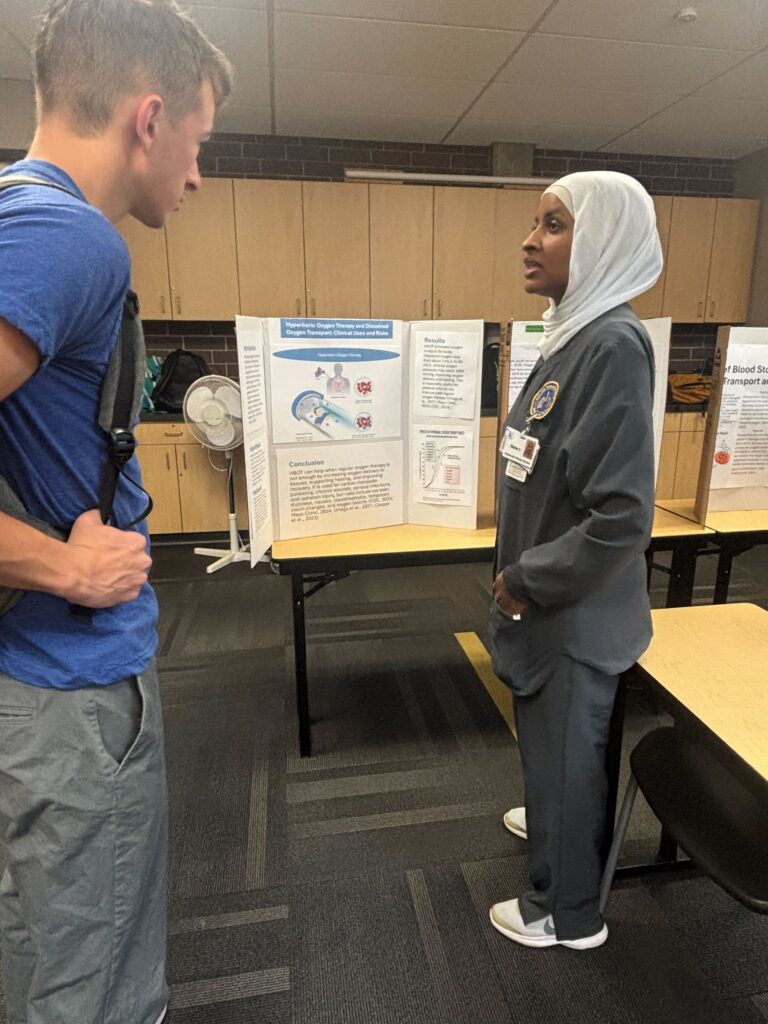
On April 21, the Respiratory Therapy Symposium took place in Linn Hall. First-year students of respiratory physiology displayed their projects on trifolds placed around the room.
Professor of Respiratory Physiology Susan Parvin said her students have been working on these projects since the beginning of the semester.
This is the third year for the symposium. Parvin said that one of the reasons why she started the symposium is that she wanted her students to work on their communication skills, making sure they have good eye contact and communicate clearly with strangers.
She said these skills are especially important in the medical field and fine tuning the skills early is extremely beneficial.
“It’s more important for the patient to understand rather than sounding like the smartest person in the room,” said Jessica Chappell, respiratory therapy student.
One of the students, Juan Cedeno, said, “I was nervous for this event.”
Every year, there is a different theme for the projects. Last year, the theme was anxiety. The theme of this semester was oxygen transport.
With each project having a focus on oxygen transportation there was an array of topics covered. Topics included methemoglobinemia, hyperbaric oxygen therapy, blood transfusion, red blood cell deformability and high-altitude exposure.
In the middle of the symposium, last year’s students entered to check out the projects.
Parvin mentioned how it is beneficial for second-year students to come back to the symposium and see what first-year students are doing.
This event also helps students with their final paper and speech that takes place during finals week.
A semester-long project being finalized is also a direct practice to real-life medical scenarios where professionals have to efficiently convey what they know in a way that patients can understand.
Categories: News