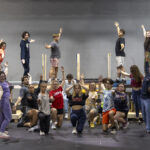





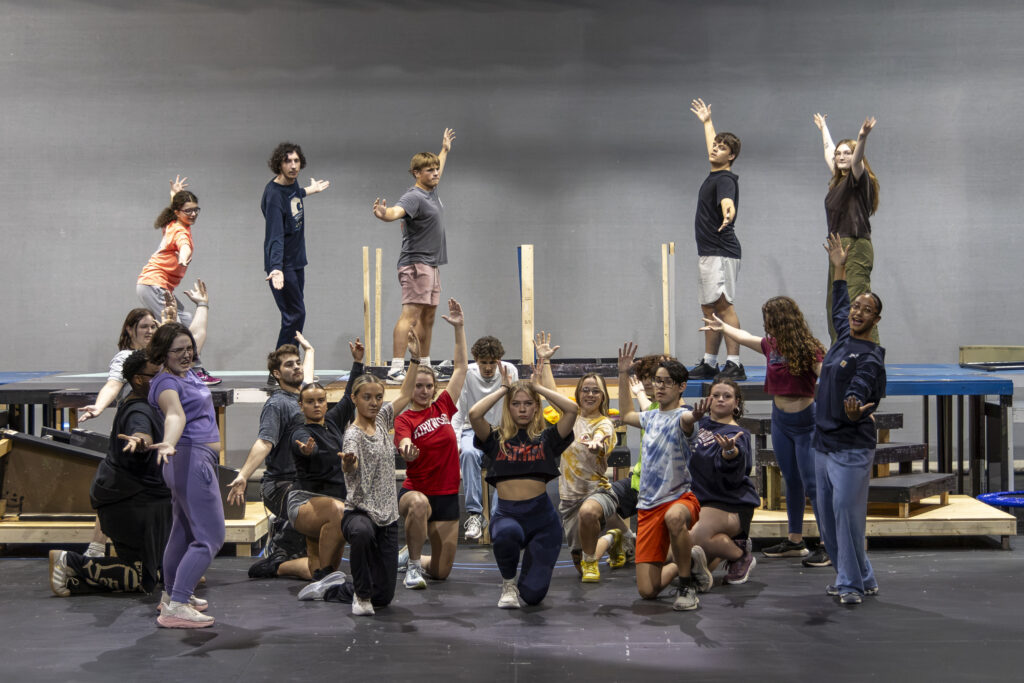
Before Pippin can find his “Corner of the Sky,” someone has to build it.
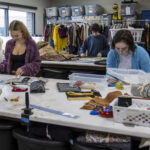
This fall, Kirkwood Performing Arts will transform Ballantyne Auditorium into a vaudeville circus for its production of “Pippin,” opening Oct. 30. But long before audiences see the finished spectacle, students and faculty are constructing platforms, sewing costumes and learning the skills needed to bring the show to life.
“Pippin” is a fantastical bildungsroman—a coming-of-age story—centered on Pippin, a young prince, searching for an extraordinary life and trying to determine what will give that life meaning. Some of its names come directly from history. Pippin was the son of Charlemagne, or Charles the Great, king of the Franks and later emperor. This musical’s version of their lives, however, is anything but a history lesson.
With music and lyrics by Stephen Schwartz and a book by Roger O. Hirson, “Pippin” first opened on Broadway in 1972 under the direction and choreography of Bob Fosse. Kirkwood is performing the 2013 revival version, which places the story within a circus troupe and turns Pippin’s search for fulfillment into a show within a show.
Adjunct theatre professor and costume designer Bre Kenney described the result as something like attending Medieval Times if Medieval Times took place inside a circus.
“It’s sort of a blend of medieval literature and inaccurate historical context with very ’70s music and Fosse dancing at a circus,” Kenney said. “So there’s a bit of smashing rather large and rather odd concepts together.”
At the center of that collision is Pippin, who moves through war, romance, family and other possible paths while trying to determine what kind of life is worth living. Around him, a troupe of performers known as the Players guides the story forward.
However, before the finished pieces reach the stage, designers working on the set, costumes, lighting and sound develop rough versions of their ideas and present how they envision their part of the production. Those concepts then have to come together to create one theatrical world.
Lead Ballantyne technician and technical director Marianna Coffey developed the set around an “elevated circus,” using platforms at varying heights and draped fabrics while working with the director’s request for a symmetrical stage.
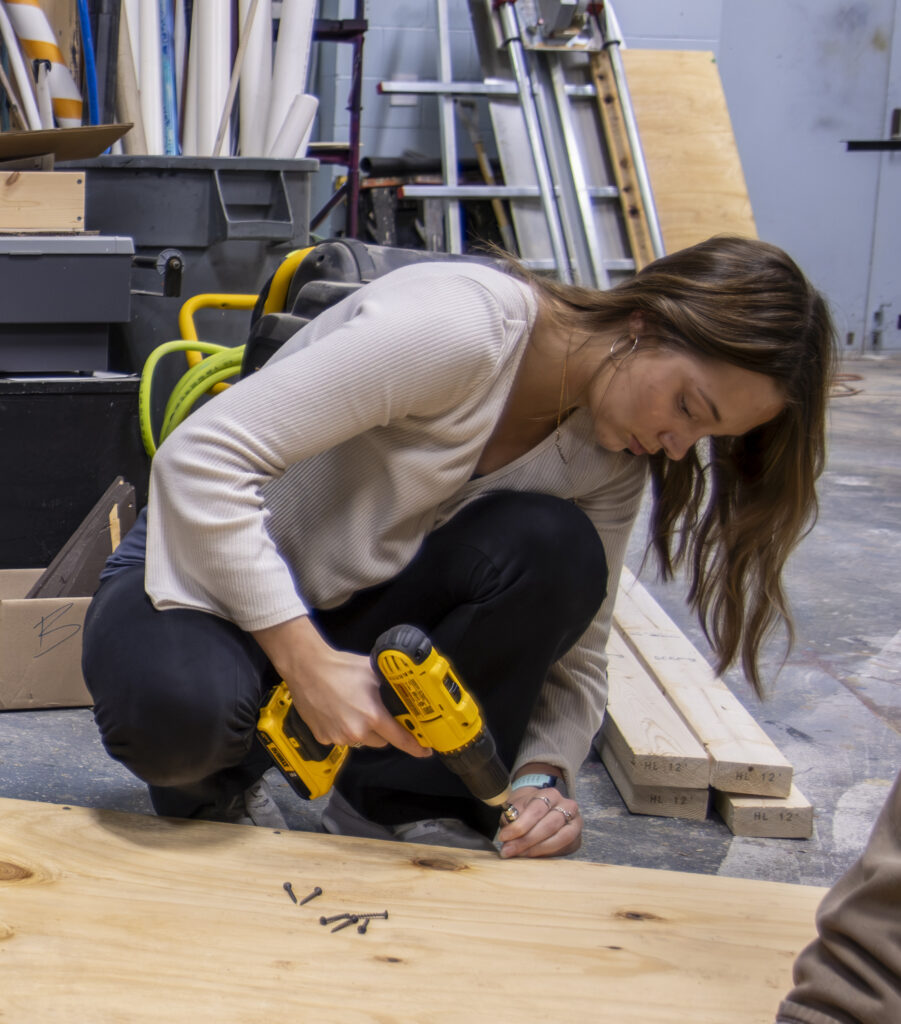
She also creates 3D renderings to help visualize the space before construction is complete.
Unlike productions where scenery is constructed elsewhere and installed near the end of rehearsals, pieces are built in the scene shop right by Ballantyne and can become part of rehearsal as they are completed. Performers are able to begin navigating and using the physical environment they will eventually occupy in front of an audience. Even the musicians become part of that environment.
“So for our musicians, we wanted to use a lot of students, and when we use a lot of students in our pit, I like them to be on stage so they can be seen,” Coffey said.
Rather than being hidden away from the audience, many of the musicians will be visible onstage. They will also have costume options to wear over their concert attire, helping them appear as another part of the circus troupe.
While the set creates the physical world of the circus, the costumes help distinguish the people inside it.
The production draws inspiration from circus archetypes of the 1920s and ’30s while combining them with a more heightened contemporary circus aesthetic. Each of the Players is associated with a circus persona, while lead characters are distinguished in part through jewel-toned color palettes.
At the center of the circus is the Leading Player, the narrator and ringleader, who guides both Pippin and the audience through the production.
“Our Leading Player is the most standout, I think, because she’s the spine of the show,” costume designer Bre Kenney said. “She changes it up a bit throughout the show, but she’s the one who keeps bringing us back to the idea of ‘circus’ and reminding us that this isn’t a real situation.”
This year, some of what students sewed began its life as something else entirely.
“We’re doing a lot of recycling with this show,” Kenney said. “So we’re taking apart old prom dresses, bridesmaids’ dresses and really random things we like the fabric or pattern of and using them for the costumes.”
The process gives old garments an entirely different life onstage.
“We’re doing a lot of ‘turning things into other things’ for this show, and being able to do a show that is recycled, I think, is a nice way to sort of pay homage to that circus history,” she continued.
For some students, that transformation is happening on both sides of the curtain.
Many cast members are also enrolled in technical theatre lab, where students learn the skills needed to construct scenery and costumes for the production for which they are rehearsing.
For first-year music major Madisen Kleppe, who plays a fortune teller among the Players, that means switching between two very different kinds of work.
“One is more interpretive, and one is more objective,” Kleppe said.
Some lessons have been as straightforward as learning how to use tools. Others require becoming more comfortable onstage.
“You have to be super outgoing,” she said. “You kind of just have to get out of your shell and know that you’re not being judged.”
Doing all of that while balancing classes and rehearsals has required its own lesson in time management.
“I always have something going on,” Kleppe continued. “Procrastination is not your friend.”
Jeffrey Harrington, the music major playing Pippin, took the technical theatre lab last year with no previous sewing experience.
“Before last year, none — absolutely zero experience with sewing,” Harrington said. “It’s actually been really nice to learn how to do it because now if I rip my clothes, I can sew it up. Oh, and I made my Halloween costume last year.”
| ‘Pippin’ Showtimes |
| Oct. 30 – Oct. 31, Nov. 5 – Nov. 7 – show begins at 7:30 p.m. Nov. 1 – show begins at 2 p.m. Tickets are available online for $10 general admission and $5 for students and seniors. Admission is free for Kirkwood students, faculty and staff with a valid EagleCard. |
Eloise Prince, the music major playing the Leading Player, has also worked on the production’s costumes. Her work included sketching decorative ideas for some of the more elaborate pieces.
“I was also getting to kind of mess around with more of the artistic side of the costume design, like sketching things out to help decorate one of the many elaborate bases,” Prince said. “Which is always cool when you not only get to say you made something, but that you also came up with this idea or this design that got to join in with this piece. Not only did it come from my labor, but it kind of camefrom my brain too.”
Not every element students and faculty create is meant to draw attention to itself.
Sound designer Jacob Kilburg approaches the production by making sound feel like a natural part of the world onstage rather than something separate from it. Effects are designed to blend with the performers and orchestra so audiences remain immersed in the production instead of thinking about the technology producing what they hear.
He also develops pre-show, intermission and post-show music mixes, extending the atmosphere of “Pippin” beyond the scenes themselves. The show’s heavily ’70s-influenced music and overall circus theme provide a foundation for that soundscape.
The variety within the score is one of Prince’s favorite parts of the show.
“I just love all the genres of music that we touch throughout the score,” she said.
“Pippin” also plays with the line between the people performing and the people watching them.
“It’s easy to get tired of meta shows or a show in a show, but I think ‘Pippin’ is special because there’s not as much of a disconnect,” Prince said. “It’s like you’re weirdly joining the reality. You, as the audience, are scripted to be the audience.”
Underneath the circus, acrobatics and theatrical spectacle is a much less fantastical question: How do you know whether you’re doing the right thing with your life?
For Harrington, that makes Pippin’s search particularly recognizable to college students.
“The whole thing,” he said when asked with what students might connect. “Because, I mean, how many people in college change their major? Like, it’s almost guaranteed that you’re going to at least consider changing it.”
The question goes beyond choosing a major.
“That’s really what the whole thing is about,” Harrington continued. “It’s like questioning whether you’re doing the right thing or not, whether you’re striving towards the right goal, whether you’re fulfilling your potential or not and if you even need to.”
It is a search that fits a story about a prince wandering from one version of fulfillment to another, and a production being made by students still figuring out some of those questions themselves.
“Am I on the right path? Am I taking the right steps? Am I doing enough in my life?”
Harrington’s answer?
“You’ll have to watch the show to figure out the answer.”
“Pippin” opens at 7:30 p.m. Oct. 30 in Ballantyne Auditorium on the first floor of Iowa Hall. Additional performances are at 7:30 p.m. Oct. 31, Nov. 5, Nov. 6 and Nov. 7, with a 2 p.m. matinee Nov. 1.
Tickets will be available online for $10 general admission and $5 for students and seniors. Admission is free for Kirkwood students, faculty and staff with a valid EagleCard.
Categories: Art & Life