






Pura Vida, or pure life, is the foundation of Costa Rican culture, and a group of 11 Kirkwood students got to experience it firsthand.
On April 12, this mix of future conservationists took flight to one of the most biodiverse countries in the world. Throughout the following week, they traveled through the mountains and oceans of Costa Rica, exploring conservation practices in various ecosystems.
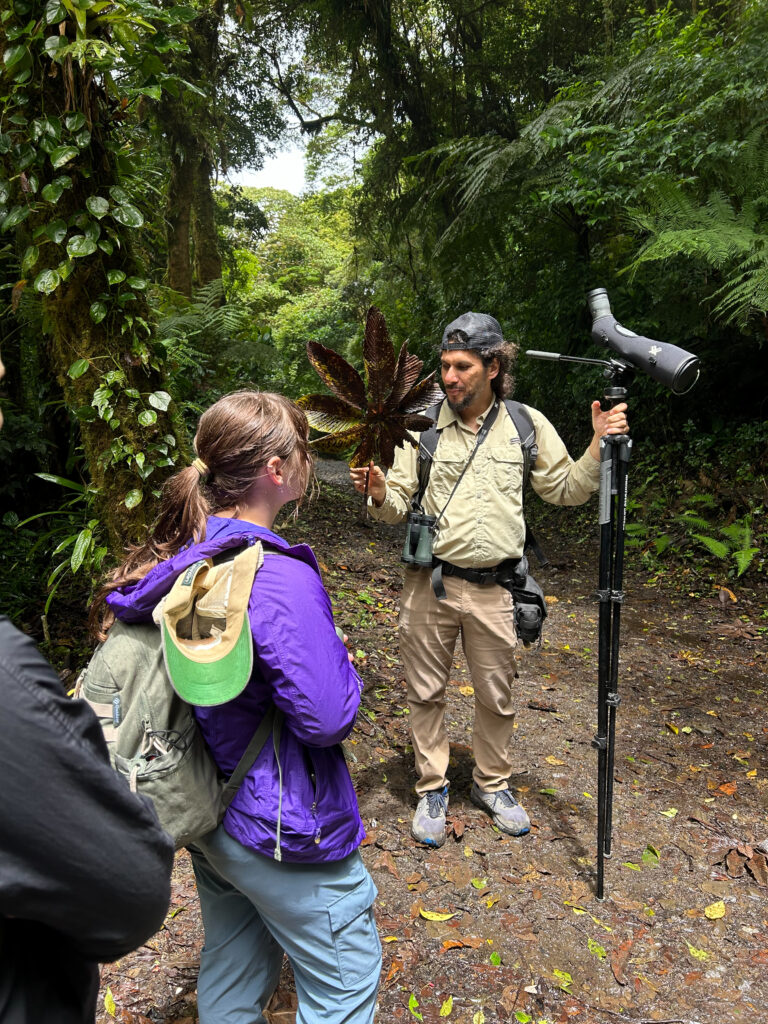
Under the guidance of Fabricio Camacho, an expert in agroforestry and sustainable land management, the students gained a new passion and understanding of what it means to protect our beautiful planet.
Camacho took them coast to coast to get this hands-on approach from the perspective of a native Costa Rican himself.
The first stop was the cloud forests of Monteverde and a stay at the Tropical Agroforestry Institute, where ecotourism benefits both travelers and the Costa Rican economy.
The Kirkwood team explored both old-growth forest and reestablished forest systems that support healthy tourism. Camacho explained how tourists bring in educational opportunities for conservation as well as funding for projects like the Monteverde Cloud Forest Biological Reserve.
Students hiked and searched for wildlife and plants that call this ecosystem home. They even saw a male quetzal, an iconic colorful bird of Costa Rica.
Next on the agenda was visiting a sustainable coffee farm, where students got to see agroforestry in action. The local farmer showcased how harmony between the animals and native plants of the land can benefit agriculture over monoculture.
The group became stewards of the land and culture themselves by squeezing their own sugar cane juice, making empanadas and watching the process of getting coffee beans from start to finish.
Having waved goodbye to their farm experience, the students traveled down to the Gulf of Nicoya and watched as pastures and monoculture became more abundant.
A forest fire’s glow on the horizon signaled the impact of human interference. Once in a local fishing town, they geared up for a boat tour of the mangrove ecosystem, where life teemed with water-loving birds. The students learned of the importance of mangroves for flood control and water health, while also learning the history of how the Gulf of Nicoya became a protected environmental zone after years of overfishing.
The human hunt for wildlife in Costa Rica left a stain on the history of the Caribbean coast as well, between massive banana plantations in place of forest and egg poaching of leatherback sea turtles.
However, Kirkwood students saw the light at the end of the tunnel through civilian conservation efforts in Parismina. Their stay on the coast led them to a pitch-black nighttime beach walk, where they assisted with the conservation of a nesting leatherback sea turtle.
After watching the young turtle mother lay more than 100 eggs and then disappear back into the sea, students were left in awe of how an untouched and clean beach can mean a world of difference to preserving the species.
While on the Caribbean coast, they traveled the canals of Limon province and stayed in the sustainable Green-Gold Ecolodge.
From sea turtles to rainforest, the Kirkwood students next shifted gears to the Veragua Rainforest.
Camacho introduced the group to researchers in a variety of interests, from biology, herpetology, entomology and everything in between.
The students studied frog habitats and life cycles, where they saw clusters of frog eggs and swimming tadpoles. Following that, they became entomologists by searching for and noting insect species of the rainforest.
A night walk concluded the students’ research journey with a look at bat mist-netting and forest ecology.
The trip concluded with the warm, vibrant blue beaches of Cahuita. After a relaxing dip at a black-sand beach, students hit the town to immerse themselves in the mixing pot of Cahuita’s culture.
The group snorkeled and viewed the shimmering fish of the coral reef, as well as the efforts of Cahuita National Park to create coral nurseries. In the national park itself, natural coastal life is preserved, and monkeys and sloths can be seen occupying the trees.
As the plane soared over the mountains of Costa Rica back to Iowa, Kirkwood’s students were left with not only memories and newfound knowledge but also inspiration to continue the conservation of Iowa’s ecosystems. Under the encouragement of Camacho, they brought home the most valuable souvenir: tools for making an impact no matter how big or small.
The students gained a new understanding of what Pura Vida means for their own lives, especially as future conservationists.
In the words of Camacho, “You know how amazing the world is here, in Iowa, everywhere. We just need to give nature a little chance. One tree at a time, one plant at a time, one bee at a time that we can help.”
Categories: Art & Life